Diaspora DNA
A service design project for DiasporaDNA Story Center™, a Philadelphia non-profit that leverages archives, art, storytelling, and community participation to preserve the culture of the global majority.
ROLE
Service Designer
TOOL STACK
Miro · Figma · Airtable
CLIENT LEADERSHIP
Monica O. Montgomery (Founder) · Varissa McMickens Blair (Impact Director)
DURATION
2 Months
TEAM
Sara Her · Grace Ho · May Kim · Mars Nevada
About the client
DiasporaDNA Story Center™ is built on founder Monica O. Montgomery's philosophy of "Healing Through Heritage." The organization uses archives, art, storytelling, and community participation to construct Public Memory, the collective way communities preserve and transmit history. Save Philly Festivals serves as one of their flagship initiatives, bringing together festival producers, community members, and cultural practitioners across Philadelphia.
This reframing shifted the project from asking "How do we increase survey completion?" to "How do we make being heard feel integrated into the experience itself?" Every design decision that followed was an answer to that question.
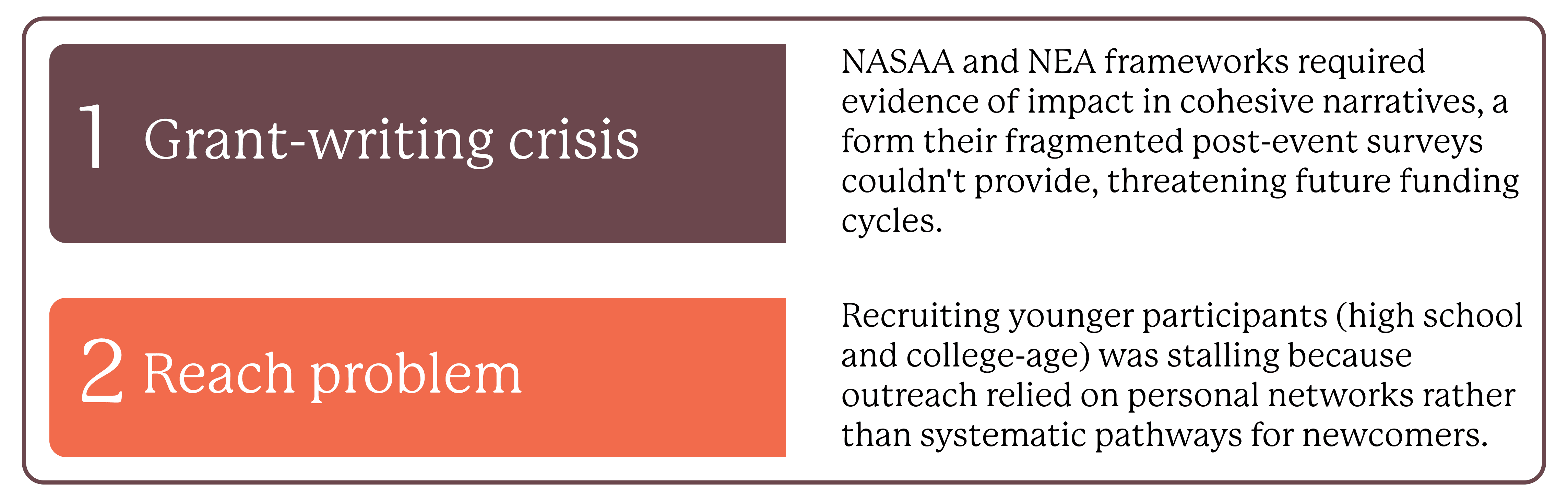
How might DiasporaDNA develop a more comprehensive understanding of program impact, beyond fragmented survey responses, to support future grant applications? Beneath that question lived two compounding crises.
Painting the landscape
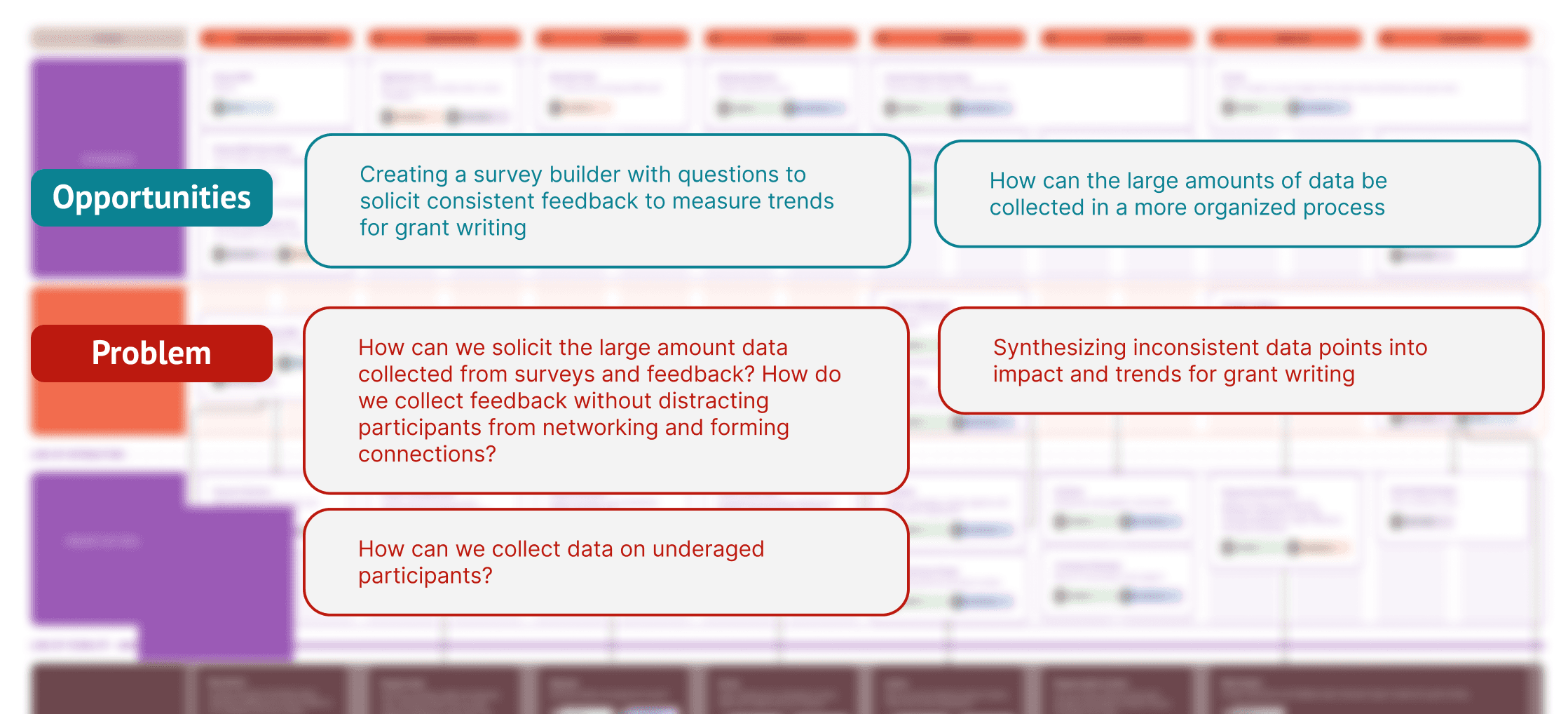
The team mapped DiasporaDNA's complete service ecosystem across eight sequential phases: Awareness, Engagement, Experience, Reflection, Retention, Donor Conversion, and Donor Retention, and four parallel systems: evidence, frontstage, backstage, and support structures.
The Reflection phase, where most data collection occurred, coincided with the lowest participant energy. Exhausted participants had minimal motivation to complete forms, especially surveys delivered a week post-event via email.
Co-design: : Thinking With the Client
Two 60-minute collaborative sessions with Impact Director Varissa McMickens Blair via video conference. The team walked through the Save Philly Festivals Think Tank journey across all eight phases, mapped participant and staff emotional states at each touchpoint, and identified existing data collection points versus potential new opportunities. A Build-a-Persona exercise generated the New Festival Producer archetype.

The eight phases of the Save Philly Festivals Think Tank, the journey we walked through with Varissa in the co-design sessions, identifying at each stage what was being felt, what data existed, and what was missing.

Co-design roleplay walkthrough, mapping what data was already being collected (yellow) and where new collection was possible (blue). The tension between gathering data and protecting the experience was already visible in the room.
"Don't want to let people get distracted, be drawn out of the experience", this constraint became a design requirement, ultimately shaping the entire Data Art Toolkit concept. Event artifacts already function as data if treated systematically.
Three-part intervention system
The blueprint, co-design sessions, and connection pointed at the same thing from three different angles: DiasporaDNA’s data problem wasn’t a single broken step. It was a broken pipeline. Data wasn’t being planned for, wasn’t being collected at the right moments, and wasn’t being stored in a way that grant writers could actually use.
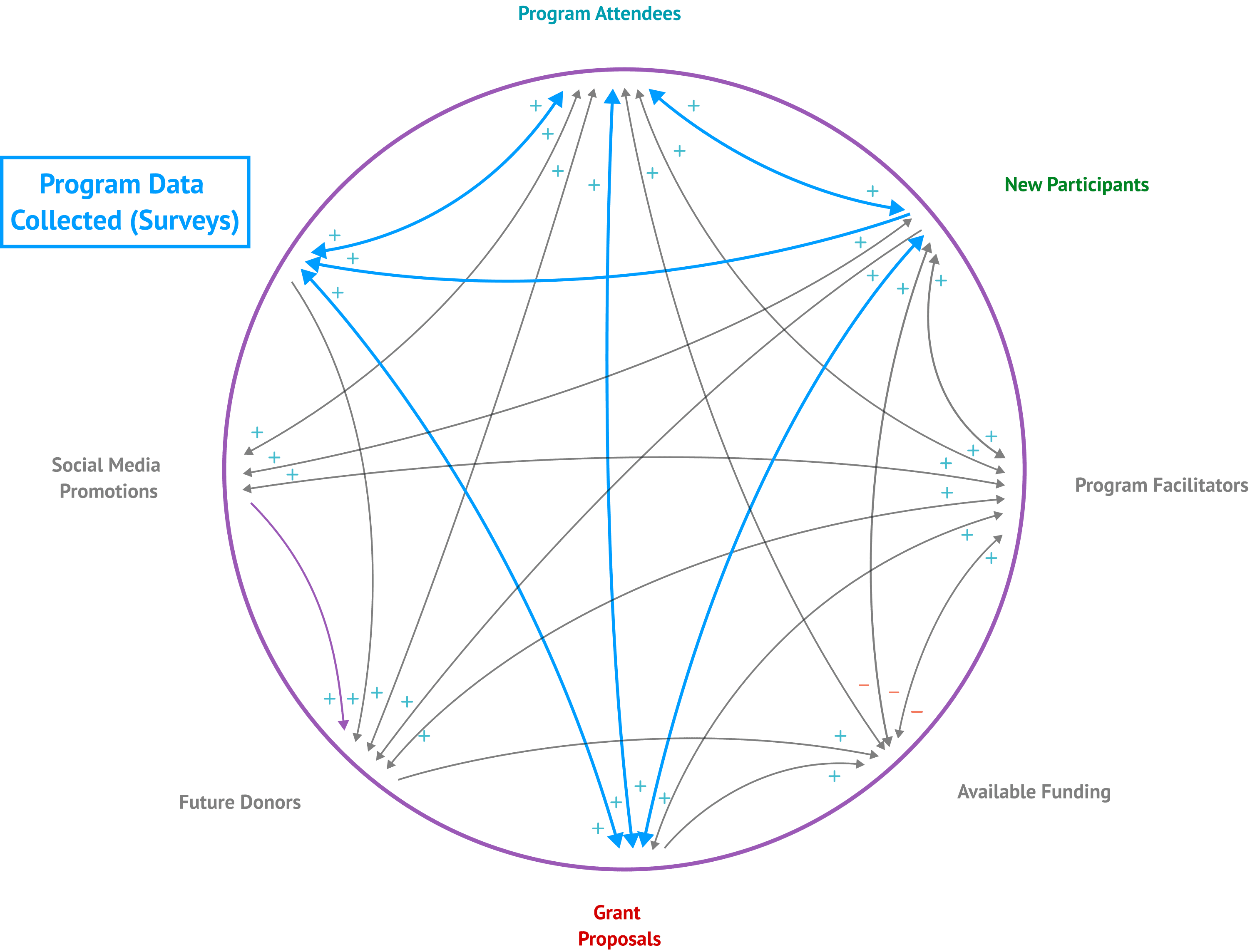
Shifts evaluation from end-stage assessment to foundational program design. Delivered as a collaborative Miro board containing structured exercises: community needs research, outcome brainstorming sessions, a logic-model worksheet, and collaborative survey development. Staff and volunteers complete the evaluation framework before programming launches — ensuring grant narratives and supporting metrics exist simultaneously, not after the fact.
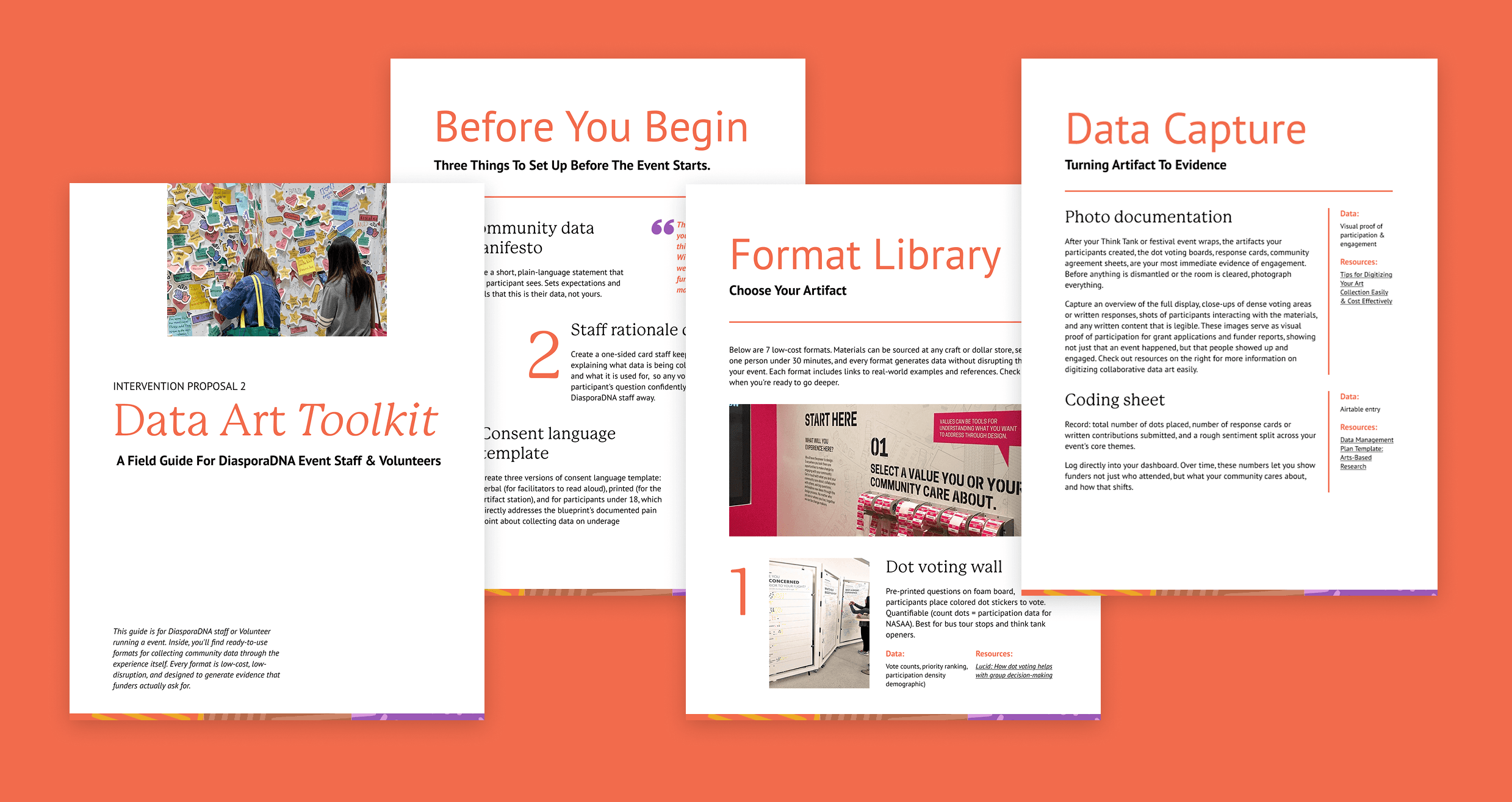
Transforms participant interaction into data while producing visual artifacts participants feel ownership toward. Each format maps to specific NASAA/NEA data categories and doubles as event photography for grant materials and social channels. The toolkit includes three foundational setups: a community data manifesto, staff rationale cards, and a consent framework with youth-specific language addressing the identified consent gap.
Dot voting walls · Community origin maps · Emotion/energy spectrums · Ribbon installations · Word walls · Conversation-starter button badges · Table cards
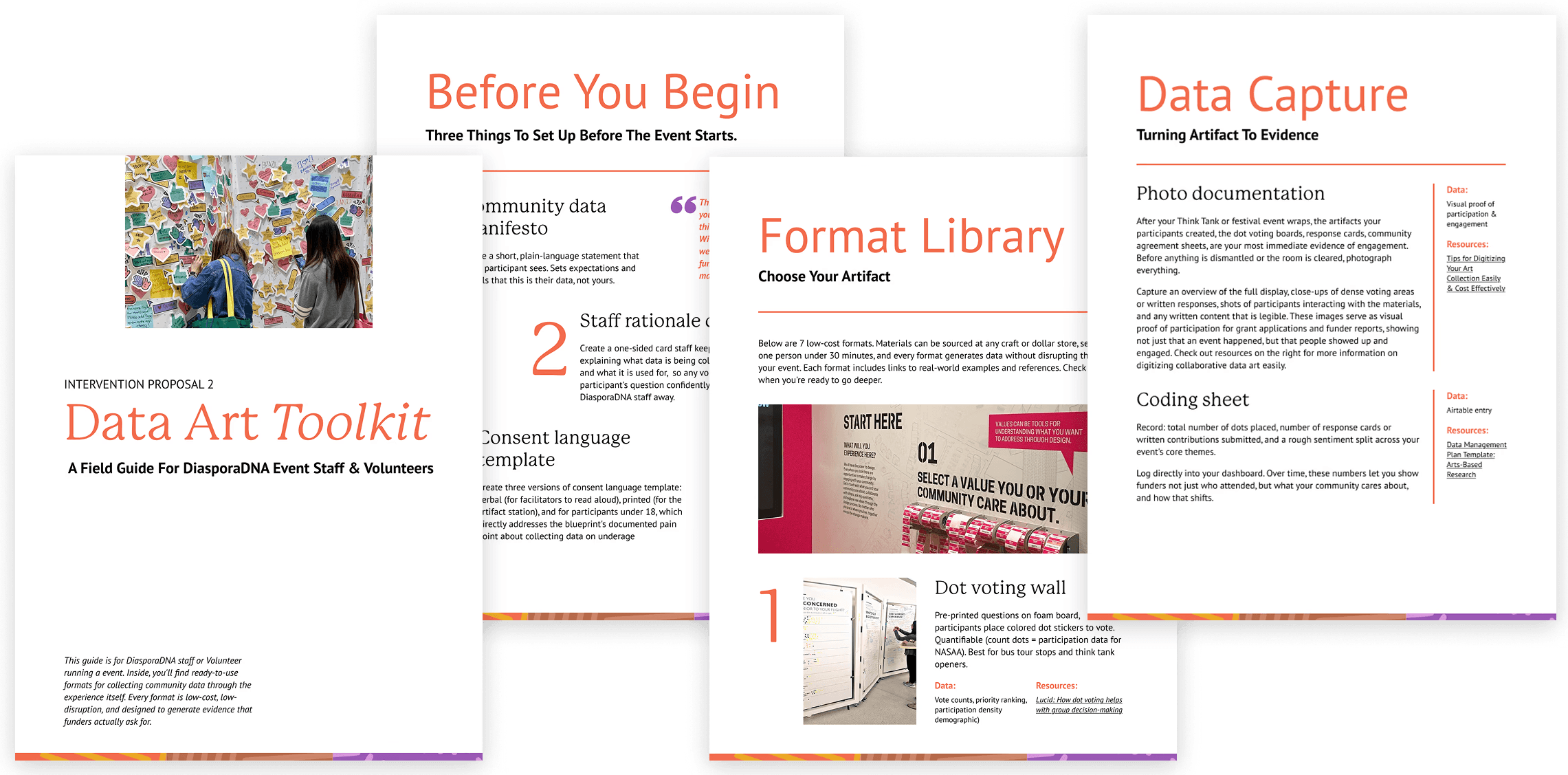
The Data Art Toolkit, from consent setup to format library to turning artifacts into evidence. A standalone field guide DiasporaDNA staff and volunteers can pick up and run with, without needing the design team in the room.
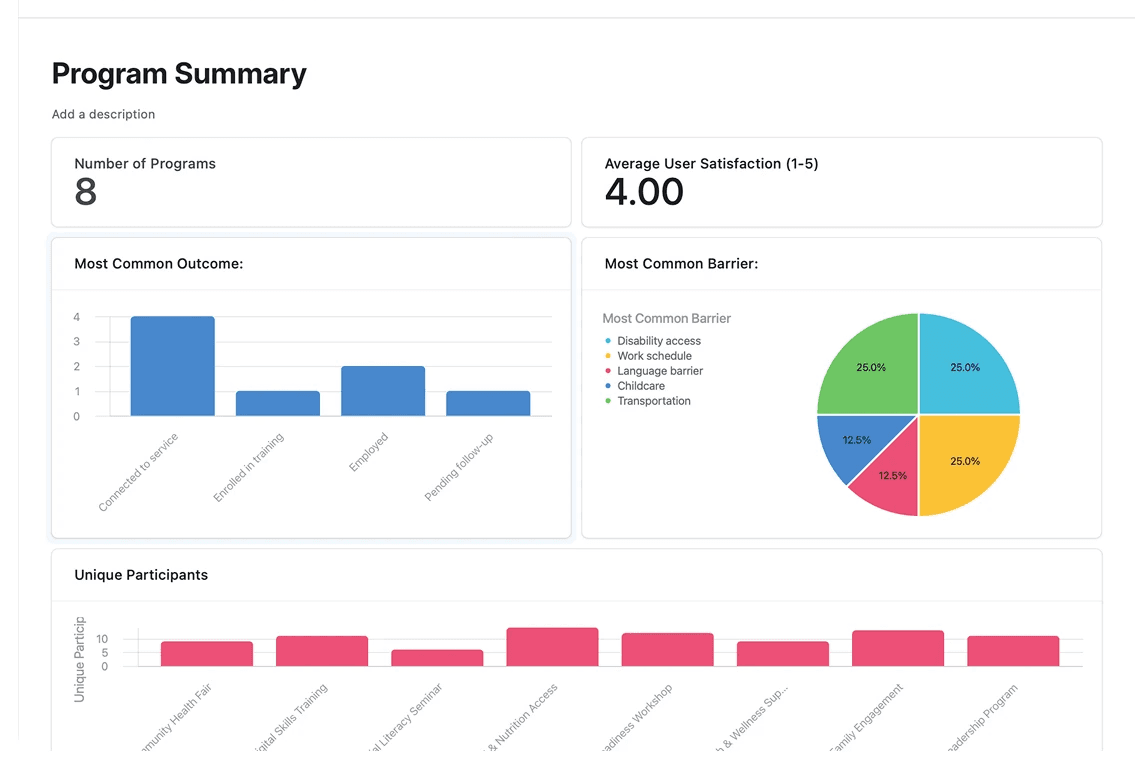
An Airtable-based infrastructure that centralises data collected through Interventions 1 and 2. Grant-ready demographic counts, sentiment analysis, and quote collections become accessible within minutes rather than hours of manual searching. The system reduces time spent hunting through fragmented data sources and produces funder-legible evidence directly from the tools staff already use during programming.
Stress-testing through
transition journeys
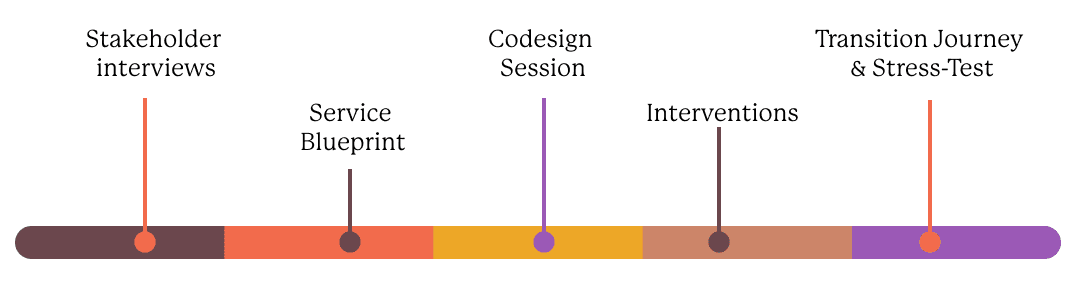
Three persona-specific transition journeys were mapped through the future-state service design to identify where the system could break down under real operating conditions.
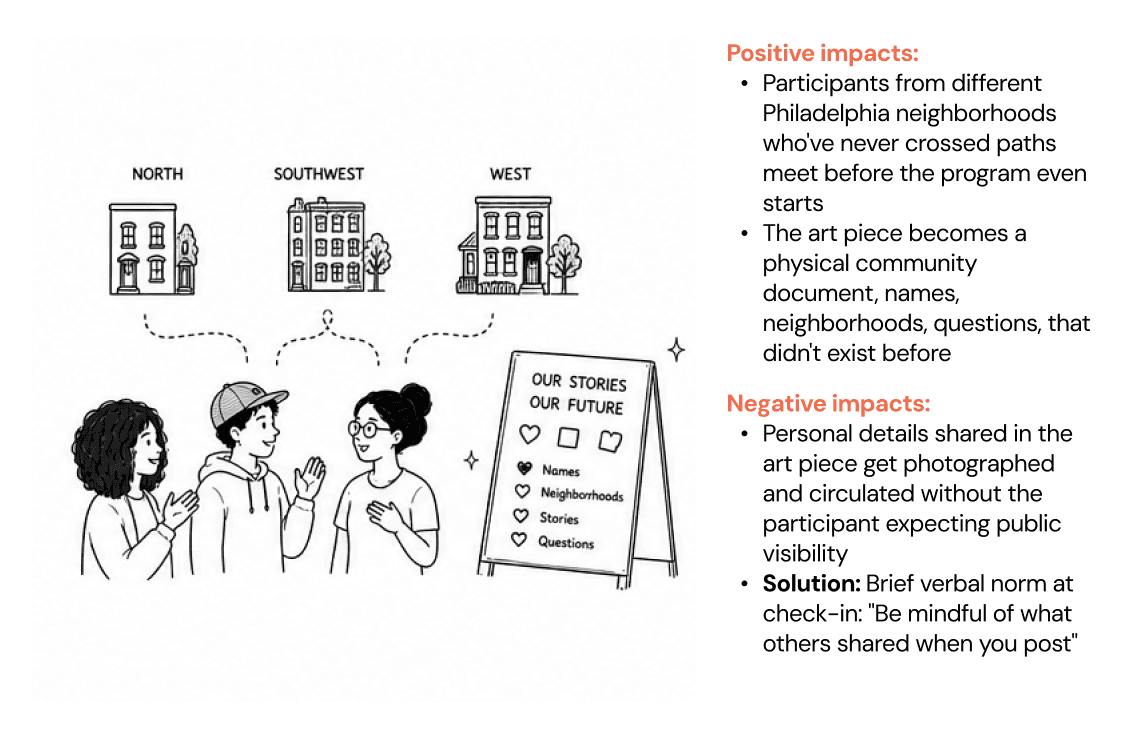
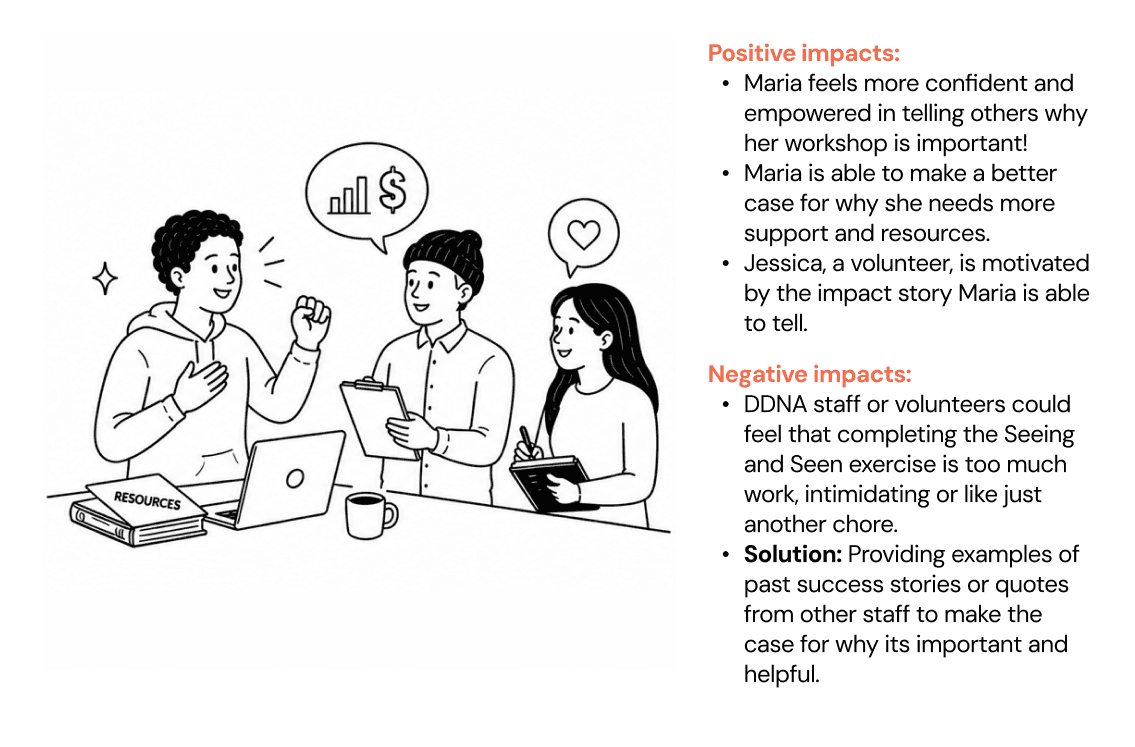
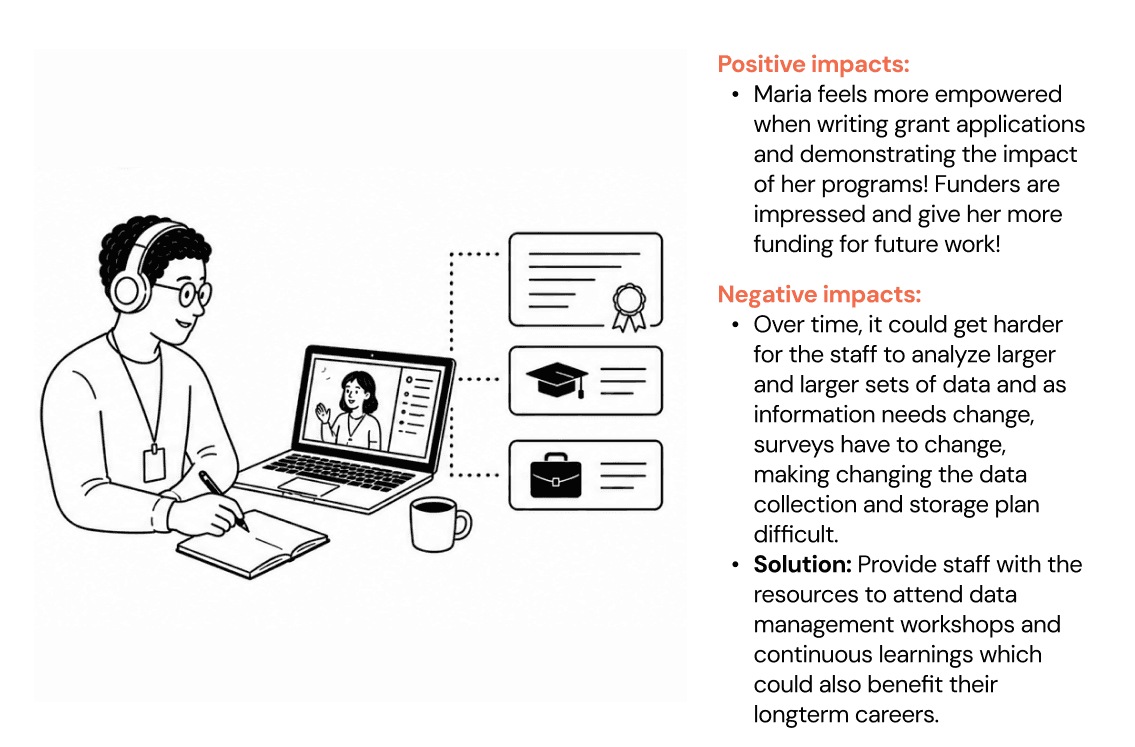
The exercise also flagged three points in the service blueprint where future work would still be needed, moments these three interventions couldn’t yet reach, but that the next phase of design should plan for. That output is what made the work feel like a real piece of service design instead of a one-off deliverable. In addition to interventions, we proposed what comes after them.
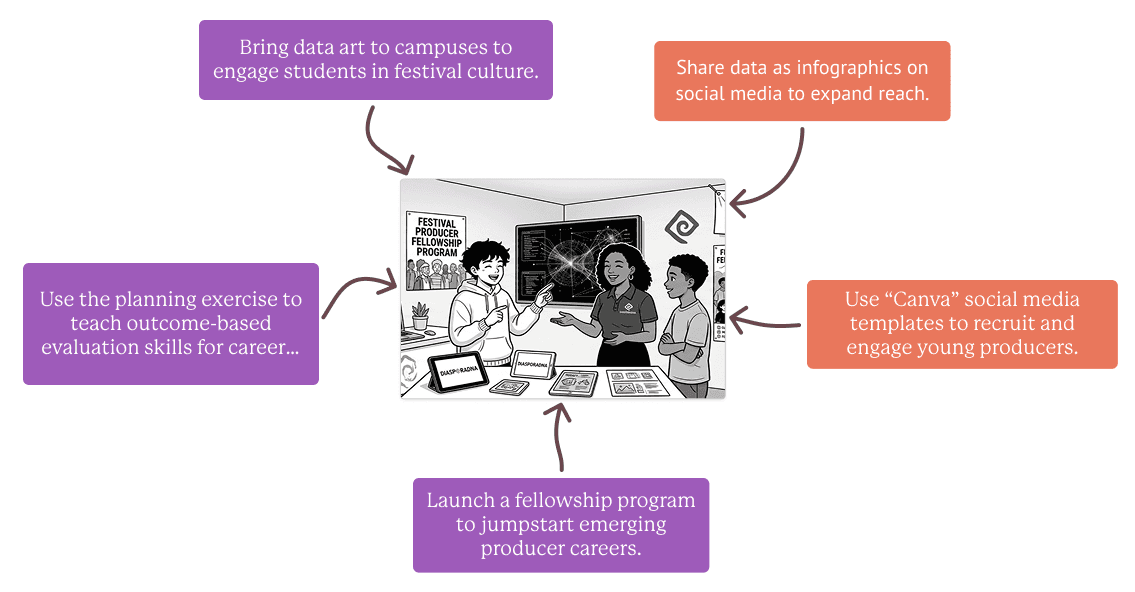
Future state vision for the New Festival Producer journey. Purple blocks show inperson actions and orange shows digital. Once the data lifecycle is in place, DiasporaDNA can move from preserving existing festivals to growing the next generation of producers who will create them.
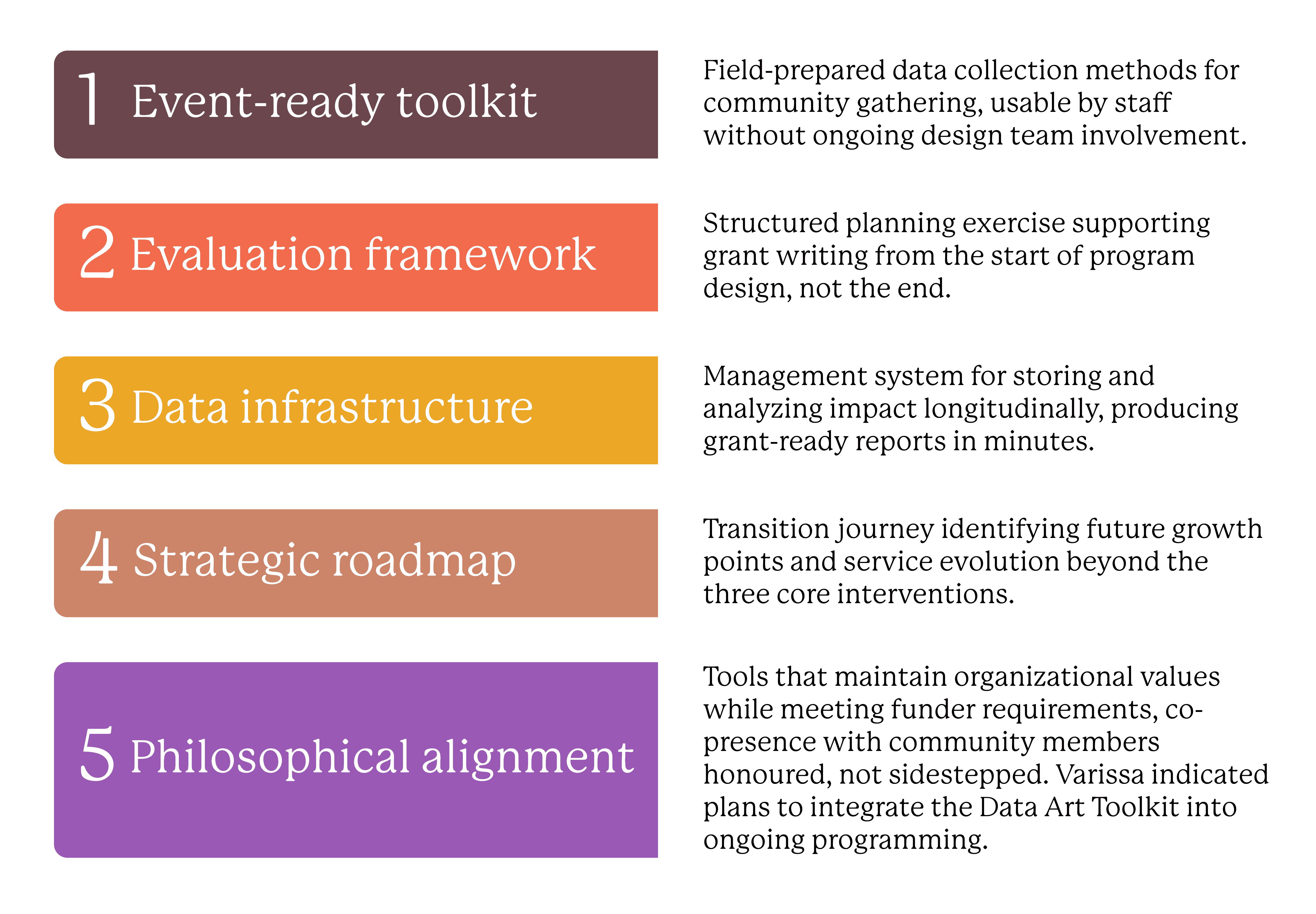
What DiasporaDNA gained (Impact)
What I took from it
The most significant insight was recognising the problem permeated the entire data lifecycle, prompting comprehensive rather than isolated solutions. Fixing only the survey would have left the planning and storage gaps untouched.
Thinking alongside clients through co-design revealed which concepts could function within actual operational constraints. The "don't distract people" insight couldn't have come from desk research alone.
Shifting data from extraction to testimony changed both the toolkit's feasibility and aesthetics. "A ribbon wall is absurd if data is a commodity. It's obvious if data is testimony."


© 2026- Shreesa Shrestha