Emission Trend
This report presents data driven exploration of vehicle emissions, manufacturer trends, and powertrain influences using the “Data on Cars used for Testing Fuel Economy” datasets from 2020 to 2025 done at EPA's National Vehicle and Fuel Emissions Laboratory (EPA). The primary goal of this report is to understand the impact of different powertrain types on CO2 emissions, analyze manufacturer trends over time, and investigate the relationship between vehicle weight and emissions.
Some of the Key Research Questions we are trying to answer are as follows:
What is the relationship between a vehicle’s equivalent test weight and its CO₂ emissions, and how does this vary across powertrains?
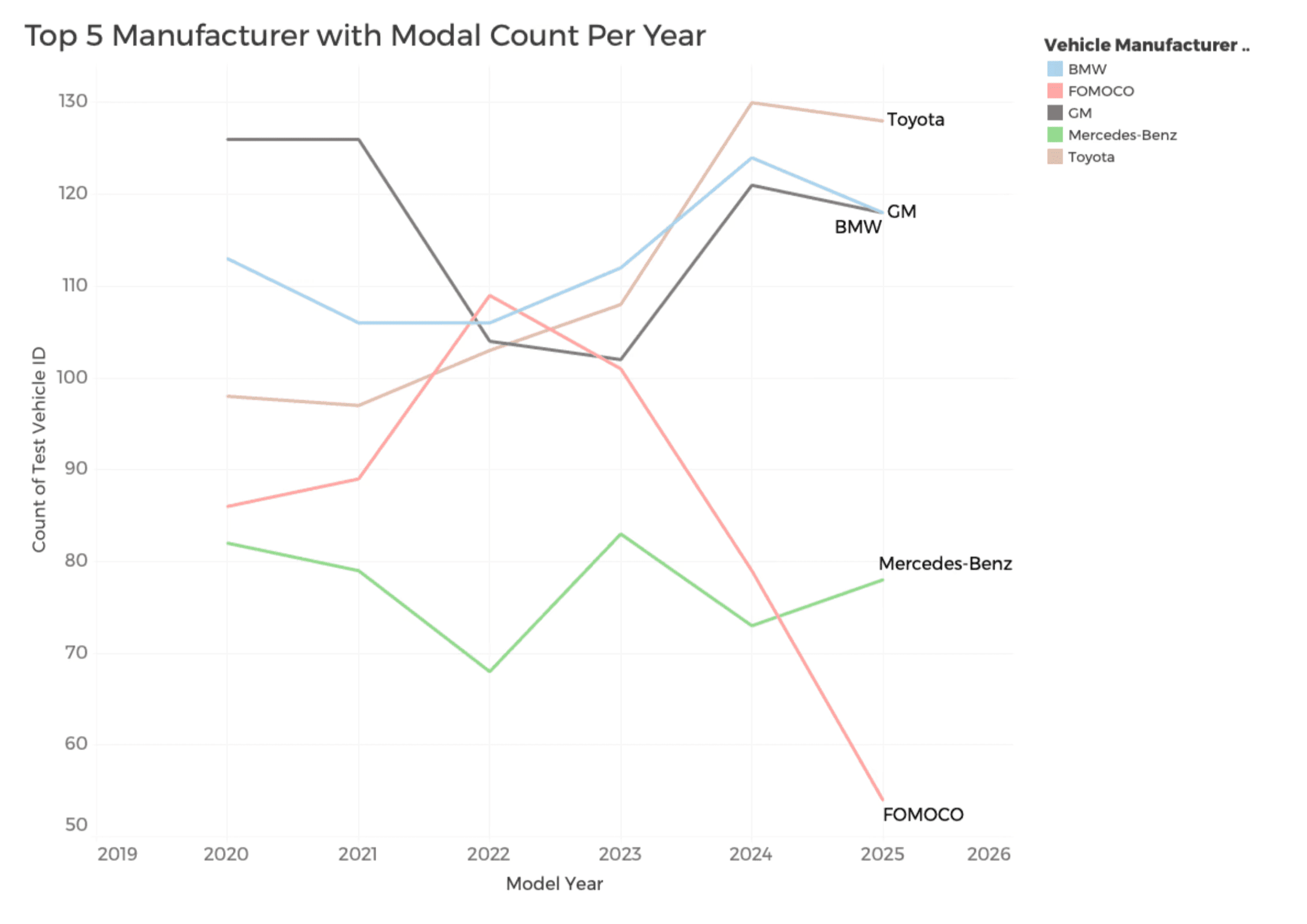
Which manufacturers have the highest number of tested models each year, and how does this trend evolve from 2020 to 2025?
🤔 TASK: Toggle through each powertrain type to compare their CO₂ emissions across weights. Which powertrain is consistently lowest in emissions?
Heavier gasoline vehicles tend to produce significantly more CO₂.
This visualization reveals the complex relationship between vehicle weight, horsepower, and CO₂ emissions across different powertrain types (Fuel Type). The data shows a clear positive correlation between vehicle weight and emissions for gasoline vehicles (R² = 0.259, p < 0.0001), indicating that heavier gasoline vehicles tend to produce significantly more CO₂. For diesel vehicles, it's not statistically significant but a weak relationship (R² = 0.053, p = 0.044), suggesting that while weight does influence diesel emissions, other factors like engine efficiency also play important roles.
Electric vehicles maintain zero emissions regardless of weight.
Electric vehicles maintain zero emissions regardless of weight (R² = 1), demonstrating their environmental advantage across all vehicle sizes. Other powertrain types show a weak correlation (R² = 0.055, p = 0.101) between weight and emissions,with the relationship not statistically significant.
This visualization effectively demonstrates why vehicle electrification represents an important pathway for reducing transportation emissions, as it breaks the traditional relationship between vehicle size, and environmental impact. It also allows users to filter by model year helping to explore trends over time.
🤔 TASK: Use the Model Year slider to view only vehicles from 2025. Are newer models trending lower in emissions?
Emissions variation within gasoline powertrains is significant, ranging from approximately 750 g/mi (Pagani) down to about 200 g/mi (Mitsubishi Motors).
This visualization highlights significant variations in CO₂ emissions across manufacturers and powertrain types. Among gasoline-powered vehicles, there is a substantial range in emissions performance—high-performance manufacturers like Pagani and Koenigsegg report extremely high average CO₂ emissions (750 g/mi), whereas brands such as Kia and Mazda achieve much lower emissions (200 g/mi), reflecting differences in fuel efficiency and design philosophy.
Diesel vehicles, particularly from Mitsubishi Motors and Volvo, average between 200-220 g/mi, positioning them lower than high-emission gasoline vehicles but still above the most efficient gasoline models. Flex-fuel vehicles display the widest variation, with Ford reporting emissions over 700 g/mi, while Jaguar Land Rover and FCA US LLC models record lower figures (300-390 g/mi).
Luxury vs. Mass-Market divide is evident, with premium manufacturers (Pagani, Rolls-Royce, Lotus, Aston Martin) having significantly higher emissions than mainstream brands.
Luxury and sports car manufacturers—such as Pagani, Roush, and Rolls-Royce—consistently exhibit the highest emissions, demonstrating the trade-off between high performance and environmental impact. Meanwhile, the exclusion of electric and hydrogen-powered vehicles (due to their zero emissions) underscores the gap between conventional and zero-emission technologies. This analysis suggests that both powertrain type and manufacturer choices significantly influence a vehicle’s environmental impact, and even within the same powertrain category, efficiency varies widely.
🤔 TASK: Use the Model Year slider to view only vehicles from 2025. Are newer models trending lower in emissions?
The provided line chart visualizes the number of test vehicle models evaluated annually from 2020 to 2025 for the five leading manufacturers: BMW, FOMOCO (Ford Motor Company), GM (General Motors), Mercedes-Benz, and Toyota. From the visualization, it is evident that Toyota has consistently increased its number of tested models, emerging as the leader in 2025. In contrast, GM and BMW display relatively stable trends, with minor fluctuations but no drastic changes.
These manufacturers maintain high test vehicle counts (between 70-130 models annually).
A particularly striking trend is the sharp decline in the number of test vehicles from FOMOCO. While initially experiencing growth, Ford’s testing numbers drop significantly after 2023, reaching their lowest point by 2025. Mercedes-Benz, on the other hand, has the lowest number of tested vehicles throughout the observed period, but its trend remains relatively stable, with minor fluctuations.
There might be several internal and external influences, including government policies, regulatory constraints, environmental regulations, selective testing strategy and shifting consumer preferences that might be affecting these patterns.
The dataset initially had many repeated Test Modal IDs, which corresponded to the same test instances across multiple entries. To ensure each record is unique, these duplicates were removed, leaving only one entry per Test Modal ID. This helped to ensure each test is represented by a single unique identifier. For each year in the dataset, only the relevant columns were extracted. This step streamlined the dataset by removing unnecessary data, making it easier to focus on the most required information related to the analysis of vehicle emissions and trends.
The data from different years were combined into a single Google Sheet, collapsing the multi-year data. This made it easier to analyze trends and changes over time. It also allowed for better comparative analysis between different years in a single, unified view. The Test Fuel Type Description was categorized into broader categories like Electric, Hydrogen Fuel Cell, Gasoline, etc. This helped group similar fuel types together, making it easier to analyze fuel efficiency, emissions, and other trends by fuel category. A set of Top Manufacturers was created based on the Test Vehicle ID, which is a unique identifier for each model. This allowed for the aggregation of test data by manufacturer, helping to analyze manufacturer trends, such as how certain manufacturers perform in terms of emissions or fuel efficiency across different years.
Tableau: Primary visualization tool to create visualizations
Google Sheets: Used for data cleaning and preparation
Future research could investigate the relationship between fuel economy improvements and stock performance to assess whether companies with better emissions profiles financially outperform their competitors. Mapping emissions data against vehicle sales would offer insights into evolving market preferences and whether lower-emission vehicles are gaining traction among consumers.
A visualization of the transition from conventional internal combustion engines to alternative powertrains (e.g., hybrid, plug-in hybrid, electric, hydrogen) would highlight the pace and direction of industry transformation. Furthermore, developing competitor analysis dashboards would provide manufacturers with benchmarking tools to compare their emissions performance, model diversification, and sustainability initiatives against industry peers.
U.S. Environmental Protection Agency. Data on Cars Used for Testing Fuel Economy (2020-2025). U.S. Department of Energy, https://www.epa.gov/compliance-and-fuel-economy-data/data-cars-used-testing-fuel-economy. Accessed March 30th 2025.
© 2026- Shreesa Shrestha